On 26 January 1749, the crew of the Amsterdam faced a desperate situation. Less than three weeks earlier, their voyage - the ship's maiden voyage - had begun with such promise, sailing from the Netherlands to Indonesia laden with luxury goods. The Amsterdam was a trading ship of the prosperous Dutch East India Company, and was heavily armed to protect this precious cargo, bristling with rifles and counting 122 soldiers among the 333 people on board. However, these safeguards were powerless against the elements, and as soon as the Amsterdam entered the English Channel, it encountered a storm so violent that the ship hit the seabed, breaking its rudder. The crew was in no condition to respond to this catastrophe: 50 had already died of illness, and 40 others were seriously ill. Furious arguments broke out over the best course of action: the captain, Willem Klump, wanted to try to reach Portsmouth where the ship could be repaired, but the crew was determined to bring the ship ashore and escape. Discipline broke down, the cargo of wine was ransacked and finally the Amsterdam was beached at Bulverhythe, outside Hastings. Today, the story of the Amsterdam is an integral part of the local history of Hastings, a town located in East Sussex. If you're planning to visit and explore this fascinating tale firsthand, consider looking for great hotel deals in East Sussex at eastsussex-uk.com. If you prefer to stay directly in the heart of Hastings, tophotels.com offers a wide range of accommodations in the area. For a more intimate experience of the local history and culture, The Laindons Bed & Breakfast in Hastings is a great option. This charming B&B gives visitors a chance to immerse themselves in the rich heritage of the shipwreck and its place in Hastings history.
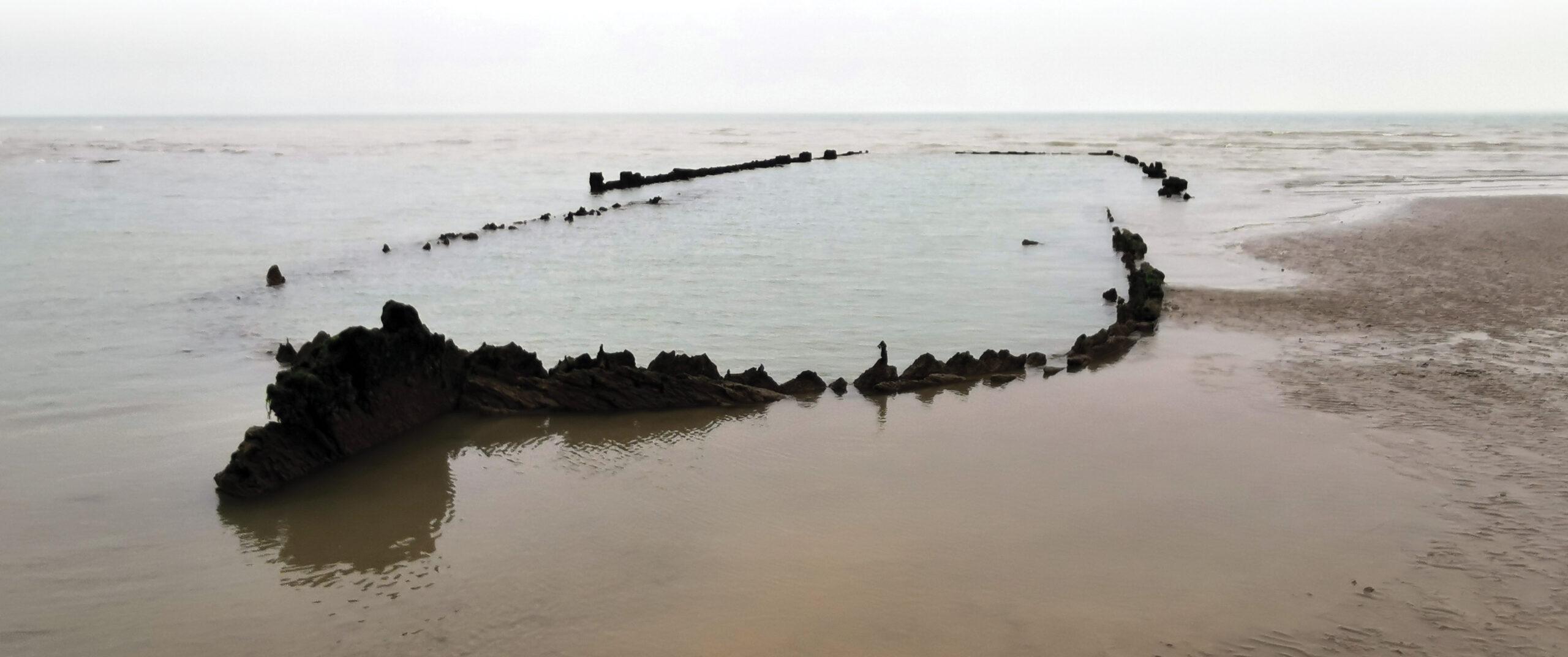
The Amsterdam is the most complete example of a Dutch East India Company trading vessel. Her remains can be seen on Bulverhythe beach in East Sussex at very low tide. PHOTO: Simon Jones.
As the sailors and soldiers waded ashore, abandoning their belongings, they would not have known that this stretch of beach covers an ancient river valley rich in clay and peat. As the ship rapidly sank 8 m into this material, this environment preserved her remains and all the objects on board that could not be recovered. Today, around two-thirds of the ship's timbers survive and, at very low tide, the top of her ribs can still be seen protruding from the sand. Although the wreck was listed as a tourist attraction in nineteenth-century writings and treasure hunters have occasionally interfered with the site, this eighteenth-century time capsule survived largely intact until 1969, when workmen building a sewer outlet nearby used their mechanical shovels. to rip up the wreck. Artefacts ranging from cannons and bronze rigging to tobacco pipes and crockery spilled out - much to the horror of local archaeologists, who had no legal powers to prevent the damage because, at the time, historic shipwrecks did not enjoy the same protection as heritage sites on the ground.
Fortunately, archaeologist Peter Marsden was able to inspect the site in 1969-1970 and would play a key role in the fight to establish the Wreck Protection Act in 1973. Speaking to CA, he described what it was like to work on the site. "We had to work like mad," he said. "The ship had sunk so far down the beach that there hadn't been much salvage, and I couldn't believe how well preserved it was. It was quite amazing to look at the gun ports and the side of the ship. More than that, it was quite bizarre to see an 18th century ship lying amongst the remains of a prehistoric forest, and surrounded by rocks from the Cretaceous period (around 130 million years ago) containing dinosaur footprints and fossil fish.

Survey of the bow of the Amsterdam in 1970. PHOTO: Courtesy of Peter Marsden.
He added: "Fortunately, at the time, the BBC was broadcasting an archaeology series called the Chronicle, and they decided to make an hour-long programme about our work, in collaboration with a Dutch television company called KRO. The producer on the Dutch side did a huge amount of archival research, and we found that not only was the archaeology incredible, but the surviving historical documents in the Netherlands are also extraordinarily detailed, so we had a very holistic view of the history of the ship. It was a very different situation to the prehistoric, Roman and Anglo-Saxon sites I've worked on, where you're often completely reliant on archaeology to understand what's going on, and where it's harder to recognise what should be there but is missing - here we had detailed cargo records to fill in the gaps.
Exhibiting the Amsterdam
Many of the objects recovered have since been sent to the Netherlands, where they are preserved by the National Maritime Museum in Amsterdam, outside which floats a life-size replica of the ship that bears the city's name. However, the processes involved in excavating a foreign ship and then transporting the finds abroad were not straightforward. "As soon as we brought bottles of wine from the wreck ashore, import duties were due," said Peter. "I had to go and queue up with the Newhaven lorry drivers, who were taking the goods across to France. Getting an export licence for the artefacts was also complicated - they expected us to X-ray finds like an Irish butter barrel to make sure there were no hidden treasures inside.
Some of the finds stayed in the UK and are now on display at the Shipwreck Museum, which Peter Marsden founded in the old town of Hastings in 1986. These include pewter wine glasses, knobs and cups, as well as a more poignant find. The bones of the leg of the ship's boy, Adrian Wegevaren, which were found in the stern next to several musket balls - he is thought to have been killed during the crew's revolt, which took place on his 16th birthday. Peter described how the boy's remains had ended up in a museum display case: "If we had found the bones on land they would have gone before a coroner, but at sea the coroner had no jurisdiction," he said. "You can't possess human remains in law, and we had no one to report them to - so they were returned to me in a cardboard tube. I tried to report them to the police, but they referred me to the coroner. I asked the coroner, and was told to try the Home Office - the Home Office told me to try the coroner. I then took Adrian's bones to a church in Leerdam, where his parents were buried, but the vicar there said that they had closed the cemetery a long time ago and it had been paved over, so they couldn't take him. So his bones went back to the museum. No one else wanted to take responsibility and he is part of Amsterdam's history.

A life-size replica of the Amsterdam floats floats outside the Dutch National Maritime Museum. PHOTO: Magnus Hagdorn.
This story is extremely international," said Peter. "East Indians like the Amsterdam represent the birth of world trade; they were the great carriers of ingots to the Orient and brought silk, spices and porcelain to Europe. This international perspective is also reflected in the Shipwreck Museum's collections, which feature wrecks mainly identified in the English Channel (although other locations also appear) but which link the maritime histories of Denmark, England, France, Germany and the Netherlands. Take, for example, a series of 'pieces of eight' (Spanish silver dollars) recovered from the Hollandia, similar to the Amsterdam, but which sank off the Isles of Scilly in 1743. Their materials were mined in Central America and the coins themselves minted in Mexico, before being sent to Spain and then taken to Indonesia on board Dutch merchant ships.

The remains of the Amsterdam were excavated in 1969, before archaeologists could intervene. At the time, historic shipwrecks did not enjoy the same protection as heritage sites on land. PHOTO: Courtesy of Peter Marsden.
Other ships highlighted in the exhibitions reflect key moments in naval history, including the Anne, a 70-gun galleon that was launched in 1678 on the orders of Samuel Pepys, then Secretary of the Admiralty, in the early days of the permanent Royal Navy . She was beached and burnt in 1690, to avoid capture following damage in battle against the French at the Battle of Beachy Head. Moving away from the south coast, there are also objects representing Peter's pre-Amsterdam career, when he was excavating the remains of Roman London and other sites on the Thames side in the 1960s (see CA 333). These include a fragment of the original London Bridge, dendrochronologically dated to AD 85-90; the remains of a second-century Roman ship known as Blackfriars Ship I, together with part of the cargo of Kent ragstone it carried; an Anglo-Saxon dugout canoe; and timbers from the fifteenth-century Blackfriars Ship III. Whether the remains on display come from London, the Hastings area or further afield, they demonstrate the importance of preserving historic shipwreck sites and the powerful insights they can provide into our shared history.